Mazerance Payroll Controversy: Inside Elvis Obi's Exit
A deep dive into the Mazerance gaming studio controversy, analyzing Elvis Obi's exit letter, unverified wage claims, and the Five Case Model framework.
Reviewed by Oluwadamilola Koya · September 24, 2026
Jump to
Illustration · CareerBuddy
Advertisement
Advertisement
Advertisement
90px
Mazerance Controversy: What Elvis Obi’s Resignation Reveals About Startup Marketing vs. Payroll Realities
Elvis Obi's resignation post ran to fourteen paragraphs. It thanked the team, the co-founders, the 20,000-strong community, the investors, and the studio's contributors, known internally as Rancers. It listed the numbers: 8 million impressions, five press features, more than 600 pieces of brand and world-building content produced in eight months, and a booth at Moonshot. It ended with a promise to stay on the board because, in his words, "this is my child."
Within hours, three former team members replied underneath it with a different set of numbers. Four months unpaid, one post alleged. Seven months, said another. A third written reply stated he'd let evidence speak for itself when the time came.
Then Obi returned to X with a sentence that changed the nature of the conversation entirely: "People who worked at Mazerance are owed money. That is true and I am not going to dress it up."
Nobody in that thread was disputing that Mazerance built something. The argument was about whether the public story matched what happened to the people who built it.
What Mazerance Actually Is
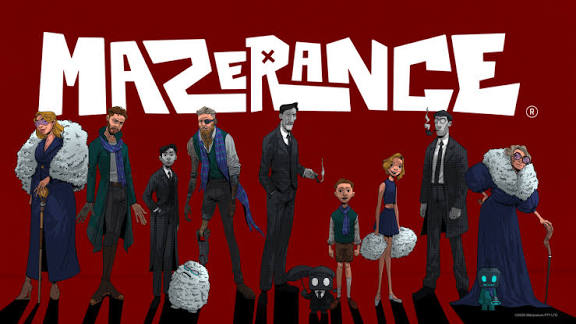
Strip away the social media thread and there is a real, registered company underneath it. Mazerance is a story-driven co-op strategy game studio operating under the Australian holding entity 5Blooded, with registration spans across Australia, Nigeria, and the US.
Reporting by TechCabal in August 2025 profiled a studio structure where the team organises itself into "factions"; creative units led by senior practitioners in their own discipline, with members spread across Spain, Singapore, Australia, Nigeria, Ghana, and Senegal. Public announcements detailed a creative collaboration with Nigerian brand storyteller Christopher "Topher" Bassey in September 2025, covered separately by Vanguard and Leadership.ng, alongside active project listings on both Steam and Kickstarter.
None of that public footprint is contested. It is also not small. A studio that has produced over 600 pieces of world, character, and campaign content in eight months— by Elvis's own account, close to three assets a day, every day— has clearly been running at a relentless pace.
What the public thread brought into question was how that pace was funded, and who absorbed the gap when the funding fell behind.
The Public Claims, and What Remains Unresolved
Initial replies to the exit letter painted a picture of severe wage arrears across the studio:
David Olamide asked what happens to people who "fulfilled their responsibilities" and were told, after a promised deadline passed, that the matter was "no longer in your hands."
Caesar, an artist with the studio, put a number on it in his reply: seven months of unpaid salary.
David Davies, posting as HidrawFX, described unresolved "disputes over compensation" and noted he would let documentation speak when the time came.
No supporting documentation was published in the initial thread replies, however, for a company that publicly listed job openings with advertised compensation (such as a June hiring post for a Motion Designer role at ₦900,000 monthly and a Graphic Designer role at ₦600,000), these unaddressed public allegations leave a gap in its public payroll narrative
Obi subsequently published a detailed response addressing the allegations directly. While acknowledging that debt existed, he pushed back against the timeline scope, offering context on Mazerance's internal contracting models:
"There are documents that contain an agreement between some of the staff members (about 5 of them) and the company on a deferred pay (read as salaries owed) before they were employed, and they all signed this... These debts were tied to a Kickstarter launch and a fundraising event which even when these milestones weren’t met, the company kept funding the team through multiple delays."
Obi clarified that the debt applied primarily to a three-month window between January and April for staff on milestone-contingent arrangements. He noted that remaining team members were offered choices earlier in the year: exit with no debt, stay at 50% pay, or continue voluntarily with deferred compensation tied to Kickstarter or merch launches.
When asked publicly why these financial realities were excluded from his initial resignation statement, Obi conceded a strategic misstep: "The post I made was focused on gratitude... I didn’t think it should be made public as there was already established communication internally. That may not have been the best decision, but I can’t take it back."
The Mechanics of Deferred Compensation in Indie Game Development
To understand how Mazerance reached this point without jumping to malicious intent, one must understand how boot-strapped game studios routinely operate and why those operational structures fail.
In early-stage technology startups, deferred compensation is common. However, standard software startups usually compensate for deferred cash with equity vesting or direct options. In indie game development, deferred pay often takes a riskier form: milestone-contingent cash liabilities.
Under this arrangement, creators sign contracts agreeing that their salaries or contract fees will be accrued on paper, to be paid out upon a specific external event; typically a crowdfunding campaign (Kickstarter), an investor bridge round, or a publisher advance.
Unilateral Downside Risk: Creative contractors absorb the financial risk of a venture capitalist or crowdfunding backers without receiving the equity upside of an early founder.
The Milestone Cascade: If a Kickstarter launch slides by two months, the studio's wage liability doubles without generating new liquid cash flow.
Cross-Border Enforcement Asymmetry: When team members are distributed across Nigeria, Senegal, Spain, and Singapore under an Australian holding entity (5Blooded), resolving payroll disputes through formal legal arbitration is functionally out of reach for individual creators.
Deep Dive: Evaluating Mazerance Through the Five Case Model
The institutional perspective raised by business analyst @ubonanalyst offers a structured framework to evaluate where the studio's strategy diverged from its operational realities.
1. The Strategic Case
Does the project solve a clear problem or capture a defined market opportunity? Mazerance established a compelling strategic fit: proving that African gaming studios can produce world-class original IP for global platforms like Steam and Kickstarter. The market demand for culturally distinct, high-fidelity co-op gaming is real and growing globally.
2. The Economic Case
Does the initiative offer genuine economic value for money? High impression counts (8 million) and press features show top-of-funnel reach, but top-of-funnel reach is not revenue. Without public data on converted wishlist additions, pre-orders, or playable demo engagement, the economic return remains unproven.
3. The Commercial Case
Is the deal commercially viable and structured to handle real-world supply chains? Operating across Australia, Nigeria, and the US while managing a distributed workforce in six countries requires sophisticated cross-border legal frameworks. When cross-border payment processors or milestone triggers lag, international remote teams bear the immediate friction.
4. The Financial Case
Is the business model affordable and cash-flow positive? When marketing outreach is fully funded while team compensation experiences multi-month delays, the financial case breaks down. Tying wage liabilities strictly to uncompleted crowdfunding rounds or future investor events exposes creative staff to venture capital risk without venture-level equity upside.
5. The Management Case
Does leadership possess the operational capacity to deliver on time? Obi noted that Mazerance’s fundamental failure was a "lack of clear communication." However, when a company's public marketing schedule is consistently more reliable than its internal financial or engineering roadmaps, it signals a deeper management delivery gap.
A business model anchored on community size and impression volume, without conversion metrics or revenue seated next to them, represents a story rather than a financial forecast. Investors who fail to distinguish between the two often end up funding stories instead of sustainable operations.
This framework applies regardless of how the compensation claims are eventually settled. A studio can simultaneously generate real marketing metrics while team members experience payment delays; the two facts are not in tension. They can be two views of the exact same operational state: a startup allocating capital toward public visibility to maintain investor interest while its underlying cash position struggles to cover both campaign outreach and payroll liabilities.
Why Game Development Amplifies the PR-Execution Gap
Game development is uniquely susceptible to this dynamic compared to standard software startups. Building original interactive entertainment requires simultaneous execution across three distinct disciplines:
Brand & World-Building: Narrative lore, character art, concept design, and community marketing.
Game Engineering: Systems architecture, netcode, physics, optimization, and bug fixing.
Production & Logistics: Multi-jurisdiction legal registration, payroll management, and milestone tracking.
The fundamental trap for early-stage studios is that Brand & World-Building produces immediate, shareable output. You can post concept art, publish character teasers, and record podcast appearances daily. Game engineering, however, happens out of sight; months of hard code optimization may produce zero visual updates for social media.
When cash flow tightens, leadership teams often double down on the visible track (marketing) to create an illusion of rapid momentum, hoping that public hype will attract the funding necessary to fix the unseen track (engineering and payroll). When that funding is delayed, the gap between what the audience sees online and what internal developers experience becomes impossible to conceal.
Philosophy vs. Reality: The Creator Economics Contradiction
The friction around Mazerance's payroll issues is heightened by the founder's public philosophy on creative valuation.
In public appearances, including an in-depth interview with Elvis Obi, Obi articulated a clear position on how creative founders and African talent should approach pricing, intellectual property, and fair compensation. He argued that African creative work is routinely undervalued globally, advocating for aggressive positioning, premium brand building, and establishing high international pay standards for local talent.
This philosophical positioning created a sharp contrast when team members publicly raised multi-month wage arrears. The controversy wasn't merely about unpaid invoices, as it was also about the gap between an ecosystem mission that championed elevated creative compensation and an internal financial model that relied on deferred wage debt to maintain momentum.
So, Where Is the Product?
Further down the reply thread, a second criticism surfaced; much quieter than the wage claims, but focused on the exact same execution gap. Multiple commenters asked a straightforward question: where is the game?
One user noted that after "more than a year of building," the public record showed "only marketing and logo showoffs." Another asked why the studio hadn't shipped a playable build before embarking on an extensive press tour.
That is a fair operational question. Mazerance produced significant marketing volume without releasing a public playable build prior to the founder's departure statement. Whether that represents a standard development timeline for an ambitious, multi-continent co-op title or signals that marketing ran far ahead of technical execution is precisely the question the Five Case Model evaluates.
Structural Lessons for the Emerging Tech Ecosystem
The Mazerance controversy offers three vital lessons for founders, creators, and investors navigating early-stage startups in emerging markets:
For Talent: Social media metrics and press features are not indicators of financial stability. Job seekers evaluating startup offers should ask detailed questions about runway, payroll management systems, and historical milestone delivery rather than relying on public brand reputation.
For Founders: Marketing velocity cannot compensate for operational arrears. Building a brand narrative that outpaces your payroll capacity creates reputational debt that explodes the moment leadership transitions occur.
For Investors: Community size without conversion data is vanity outreach. Thorough due diligence requires auditing internal milestone delivery and contractor payment histories, not just reviewing impression counts and conference appearances.
What This Actually Is
In a tweet earlier in the year, Elvis Obi stated his goal with Mazerance was to "redefine what quality means for a brand or product built by Nigerians" and to "create a pay standard for Nigerian talents globally."
His follow-up admissions demonstrate accountability regarding the existence of the debt and the communication missteps that followed. However, the broader structural lesson remains unchanged: a marketing engine sophisticated enough to publish three assets a day running alongside deferred payroll structures creates an inherent instability that public enthusiasm cannot indefinitely cover.
Mazerance may resolve its remaining liabilities as its leadership continues board-level discussions and settles account balances. Until then, the resignation post, the staff replies, and the founder's clarifications together form a complete document on the realities of early-stage startup building.
This article draws on public statements posted on X (formerly Twitter) by Elvis Obi (@TheObiLeonard) and former team members, alongside reported coverage from TechCabal, Vanguard, and Leadership.ng.