Open your banking app and look at the savings balance. The number hasn't dropped. Nothing has left the account. By every signal your bank gives you, the money is safe and slowly growing. But is it really
Now let’s do the one piece of arithmetic your bank will never do for you.
Point A: A standard savings account in Nigeria pays 7.95% a year at the moment, and that is the good version of the rate, which I must add, you get only if you keep to four withdrawals a month or fewer.
Point B: Over the year to July 2026, prices rose 15.43% .
We now get to hold those two numbers side by side. Your money earns 7.95% while the things you buy with it get more expensive by 15.43%. The difference, a little over seven and a half percent, is what the savings account costs you EACH YEAR.
That is the strange thing about a savings account when inflation is high. It feels like the careful choice. But if we’re being truthful, as you may have guessed; on the numbers it is a slow, reliable way to get poorer while you watch a balance that never falls.
So the real question isn't whether to take a risk with your money. It’s a guarantee that you are already taking one. The question is whether there is a better place to put naira you won't need for a while.
This piece walks through the honest options, with Risevest's Naira Vault as the main one on the table, perfections, advantages, flaws and all.
Why Nigerian savings account interest rates are stuck at 7.95%
Why the savings rate is stuck where it is
It helps to know why 7.95% is the number, because this isn't your bank being stingy on a whim.
The Central Bank of Nigeria sets a benchmark rate, the MPR, which is 26.5% right now. Banks have to pay savers at least 30% of that on naira savings deposits. Thirty percent of 26.5 is 7.95, and that is where nearly every big bank has left its savings rate. Access, GTBank, Zenith, UBA and Fidelity all sit at the floor, with one or two like First Bank a fraction above it.
Two things follow. Shopping around between the major banks for a better savings rate mostly wastes your time, because they are all pinned to the same minimum. And if the Central Bank cuts its benchmark later this year, that floor drops with it, so the gap between what your savings earn and what inflation takes widens without anyone telling you.
In simple terms, a savings account isn't built to grow your money. Rather, it is built to hold it and keep it within reach. That makes it right for the cash you might need this week, and a poor home for money you won't touch for a year.
Where to invest naira in 2026: your options compared
Here is the full set of places your naira can sit, and what each one pays as of the middle of 2026.
A regular savings account pays that 7.95%, is fully liquid, and is insured up to five million naira by the NDIC. That safety and easy access is the whole reason it exists.
A bank fixed deposit pays somewhere between 8 and 15% at the large banks, and more at some merchant banks, in return for locking the money for a set term.
Treasury bills, which are loans to the federal government you buy through your bank or a broker, have paid around 18% at recent auctions. They are government-backed and about as safe as naira returns get, though buying them takes a bit more effort.
The Risevest Naira Vault pays between 15% and 23% a year, depending on how much you lock and for how long.
Set them against 15.43% inflation, and it’s pretty clear the picture is plain. Only the savings account is certain to lose you ground. Everything else is at least in the fight, and a few options pull clearly ahead.
How the Risevest Naira Vault Works
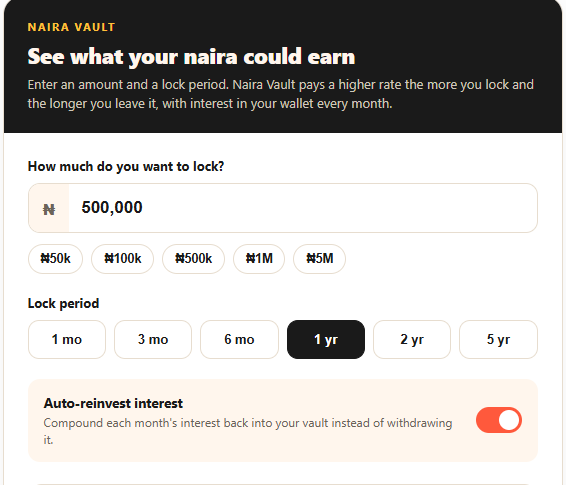
The Vault lets you lock naira for a stretch of time, from one month to five years, and pays a higher annual rate the more you commit:
Below 500,000 naira, you earn 15% a year.
From 500,000 up to just under 1,000,000, it rises to 18%.
From 1,000,000 up to just under 5,000,000, it is 20%.
At 5,000,000 and above, you reach the top rate of 23%.
Interest goes into your naira wallet on the first of every month, so the returns aren't a promise you wait years to collect. They arrive monthly and you watch them land. You can take that interest out each month, or leave the reinvestment toggle on and let it fold back into the Vault, so the next month's interest is worked out on a slightly bigger balance. Over one month the effect is tiny. Over a year or three, that compounding is where the difference between saving and investing actually shows up.

Two details change the real return, and here’s where if you haven’t been paying attention, you need to glue your eyes to the screen.
The first is tax.
A 10% withholding tax comes out of the interest before each monthly payout, so a headline rate of 15% reaches your hand as about 13.5%. That shapes how you should read the tiers. At the bottom tier, after tax, you land close to inflation rather than comfortably above it. The larger amounts and higher tiers, helped by reinvestment, are what move you into clearly positive territory.
The second is access.
Once you lock money in the Vault, it stays locked until your term is up. There is no early exit. That is the trade for a rate this far above a savings account. And money in the Vault isn't NDIC-insured, because this is an investment product run through Risevest's SEC-licensed partner rather than a deposit held in a bank.
Naira Vault returns on ₦500,000: A Worked Example
Let’s put this whole talk against a real amount: